
Success Story: BioBlack AR extends the life of a commercial parking lot while eliminating sealcoats
Executive Summary
When a commercial property owner in the Midwest faced the familiar cycle of asphalt degradation — cracking, oxidation, and mounting maintenance costs — they turned to BioBlack AR for a different kind of solution. Rather than reapplying a conventional sealcoat that offered cosmetic improvement but little structural benefit, they chose a biobased asphalt rejuvenator that could penetrate the binder and restore the pavement from within.
The results confirmed what Nature Coatings had long demonstrated in the lab: BioBlack AR extended pavement life, reduced raveling, and delivered a deep, lasting black finish — all without the PAHs, VOCs, or PFAS found in petroleum-based sealers. Applied by contractor Steve Wallace at Greene Technologies, the project became an on-the-ground proof point for a product that is redefining what responsible pavement preservation looks like.

The Challenge
Asphalt Doesn't Age Gracefully — and Conventional Sealcoats Don't Help Enough
Asphalt is one of the most widely used surfaces in commercial real estate — and one of the most neglected. Over time, UV exposure and oxidation break down the asphalt binder, causing the pavement to lose flexibility, develop surface cracks, and begin to ravel. Left untreated, the Pavement Condition Index (PCI) of a typical parking lot drops from 100 (new) to below 40 within 15 years, at which point full replacement becomes necessary.
The conventional response — coal tar or petroleum-based sealcoats — offers a cosmetic fix that darkens the surface and seals minor cracks but does little to restore the underlying binder chemistry. These products also come with significant health and environmental liabilities: coal tar sealers contain polycyclic aromatic hydrocarbons (PAHs), volatile organic compounds (VOCs), and PFAS compounds that leach into soil and waterways.
For this particular property, the goal was simple: find a preservation solution that worked better, lasted longer, and didn't come with a toxic footprint. Sealcoat wasn't enough. Repaving was premature and expensive. There had to be a smarter path.
The Solution
A Biobased Rejuvenator That Goes Below the Surface
BioBlack AR is not a sealcoat. It's a penetrating asphalt rejuvenator — one that restores the maltenes and rebalances binder chemistry that oxidative aging has depleted. Unlike surface coatings that sit on top of the pavement, BioBlack AR works from within, reversing the brittleness that leads to cracking and raveling.
The product is 98.9% biobased, made from FSC-certified wood waste, and verified carbon neutral. It meets FAA P-632 performance standards for bituminous pavement rejuvenation — meaning it satisfies safety requirements rigorous enough for airport runways and military facilities, not just commercial parking lots. And critically: it contains no PAHs, no VOCs, no PFAS — none of the toxic compounds that have made conventional asphalt maintenance a liability for property owners and local ecosystems alike.
Application is straightforward. BioBlack AR is compatible with standard spray equipment, requires no sand for traction, and cures quickly without tracking via foot or vehicle traffic. For applicator Steve Wallace at Greene Technologies, the process was efficient and the results were visible immediately.
"I've applied a lot of products on a lot of surfaces. BioBlack AR went down clean, cured fast, and the finish was noticeably different — darker and more uniform than anything I'd used before. There was nothing complicated about it." — Steve Wallace, Senior Board Member at Greene Technologies
The Results
Pavement Condition — The Story the Graph Tells
One of the most useful ways to understand BioBlack AR's value is through the lens of the Pavement Condition Index — the industry-standard 0–100 scale used to assess pavement health. New asphalt scores near 100. At around 40, replacement is typically required.
Without any preservation treatment, a commercial parking lot will typically reach a PCI of 40 within 15 years, at which point costly full replacement is unavoidable. The pavement degrades in a steady arc — and there's no intervention to slow the curve.
BioBlack AR changes the trajectory. Applied every three years, BioBlack AR restores the binder and bumps the PCI back up the scale — effectively resetting the clock on surface degradation. The result: treated pavement reaches year 20 before it approaches a PCI of 40. That's five additional years of service life — and five fewer years of deferred replacement costs — compared to an untreated surface.
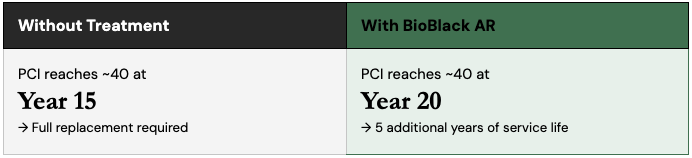
Applied every 3 years, BioBlack AR restores PCI, extending pavement life from ~15 to ~20 years before replacement is needed.
A Meaningful Reduction in Embodied Carbon
The environmental benefits of BioBlack AR extend beyond eliminating toxic ingredients. Because BioBlack AR defers full repaving by five or more years, it also avoids the substantial embodied carbon associated with manufacturing and placing new asphalt. Every ton of asphalt mix avoided is CO₂ that never has to be produced.
BioBlack AR is 98.9% biobased and independently verified carbon neutral — meaning the product itself contributes almost no fossil carbon to the atmosphere. When that's compared against the carbon footprint of a full parking lot replacement, the lifecycle savings become significant. For a property of even modest size, the reduction in embodied carbon represents a real and measurable climate contribution.
Why BioBlack AR — and Not a Conventional Sealcoat?
Sealcoats have long been the default for parking lot maintenance — and for good reason. They're familiar, widely available, and appear to restore a surface's appearance. But the comparison breaks down quickly when you look beyond aesthetics.
Sealcoats primarily seal cracks and slow moisture intrusion, offering incremental protection against further degradation. They do not restore the asphalt binder itself. They require frequent reapplication — typically every two to three years — and most petroleum-based and coal tar formulations contain PAHs that are classified as probable human carcinogens and known environmental contaminants.
BioBlack AR approaches the problem differently. Rather than coating the surface, it penetrates the binder and chemically restores it — addressing the root cause of pavement aging rather than its symptoms. The result is fewer applications needed, a longer service life, and a product that leaves no toxic legacy in the soil or stormwater around the property.
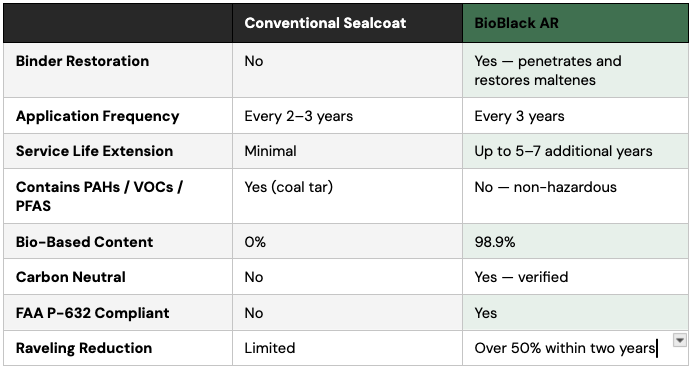
Cost Comparison: BioBlack AR vs. Traditional Sealcoat
When evaluating pavement maintenance options, cost-per-square-foot tells only part of the story. The real measure is long-term value — how often a treatment must be reapplied and what it actually does for the asphalt underneath.
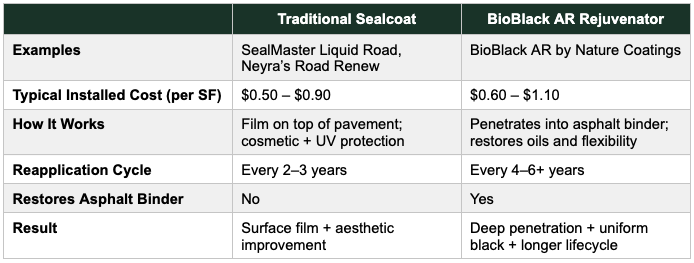
The Bottom Line: While BioBlack AR carries a modestly higher upfront cost, its ability to extend treatment cycles by 2–3x compared to traditional sealcoats translates to significant savings over the life of a pavement. For facility managers and municipalities managing large surface areas, that difference compounds quickly.
About Nature Coatings
Nature Coatings produces BioBlack — the world's first FSC-certified, carbon-negative biobased black pigment made from recycled wood waste. Originally developed for the textile and fashion industries, BioBlack is now transforming additional markets, including asphalt preservation, cosmetics, and industrial coatings.
BioBlack AR is Nature Coatings' purpose-built asphalt rejuvenator: a 98.9% biobased, non-hazardous, FAA P-632 compliant product designed to extend pavement life, reduce maintenance costs, and eliminate the toxic chemistry that has long been standard in the asphalt preservation industry.
From fashion runways to airport runways, Nature Coatings is proving that the cleanest solution can also be the highest-performing one.